
How FAT Reads Labels
Farm Animal Transparency evaluates every meat, poultry, and seafood label using the same three-step analysis. We never grade on a curve. Each step is assessed independently and surfaced for the consumer:
- What is disclosed?
- How credible is the disclosure?
- Who stands behind the label?
The result is a disclosure count — how many of the 16 transparency categories a label addresses, how credibly each is backed, and what the public record says about the company behind it. It is not a quality rating, not a nutrition score, and not a single letter grade. FAT rates the disclosure, never the food.
A meat or seafood label can tell you a lot. It can also leave a lot out.
Farm Animal Transparency helps shoppers ask three questions of any label: what is disclosed, what is verified, and what is missing? Here is what full, verification-tier-coded disclosure could look like across the case.

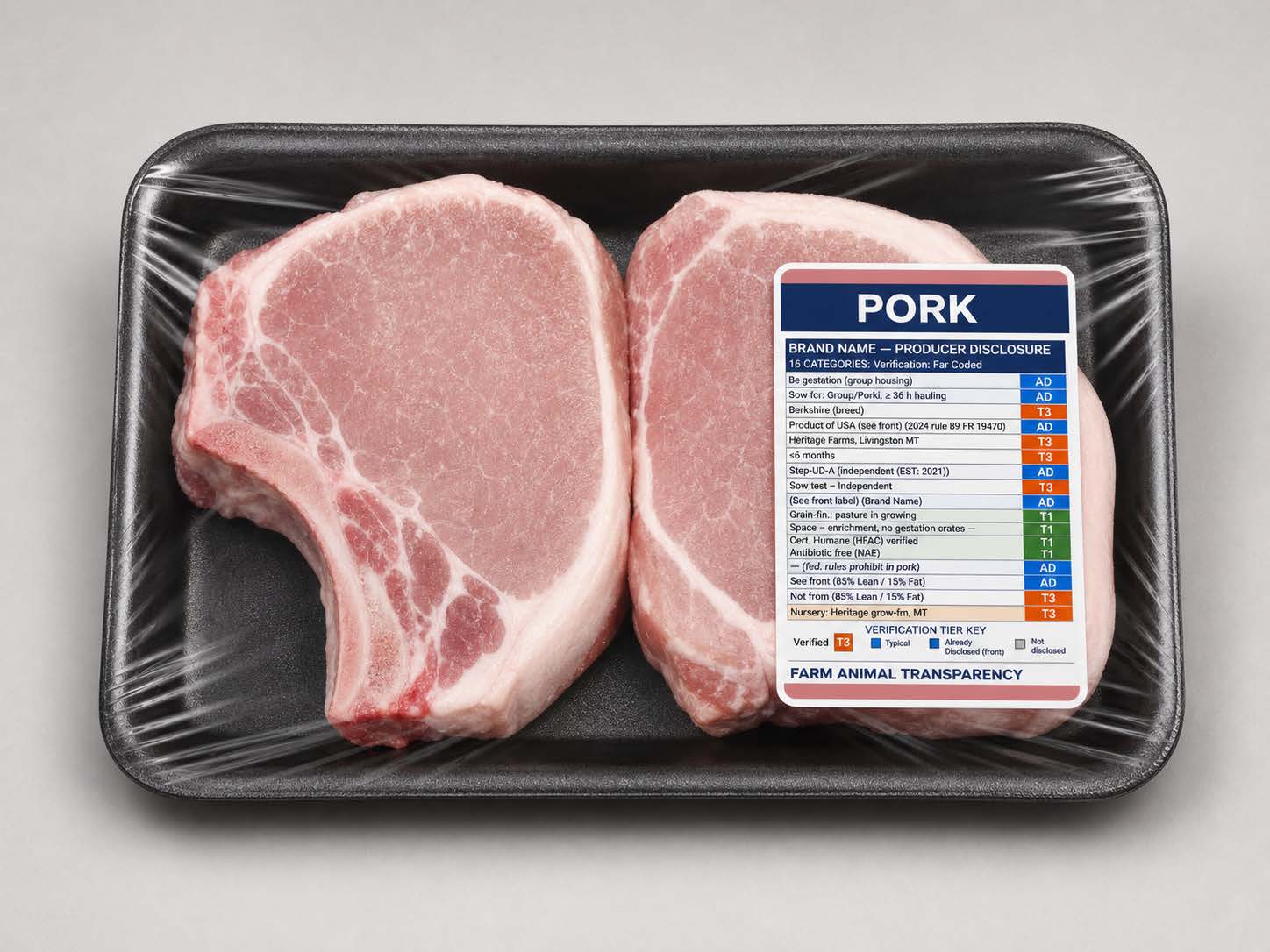

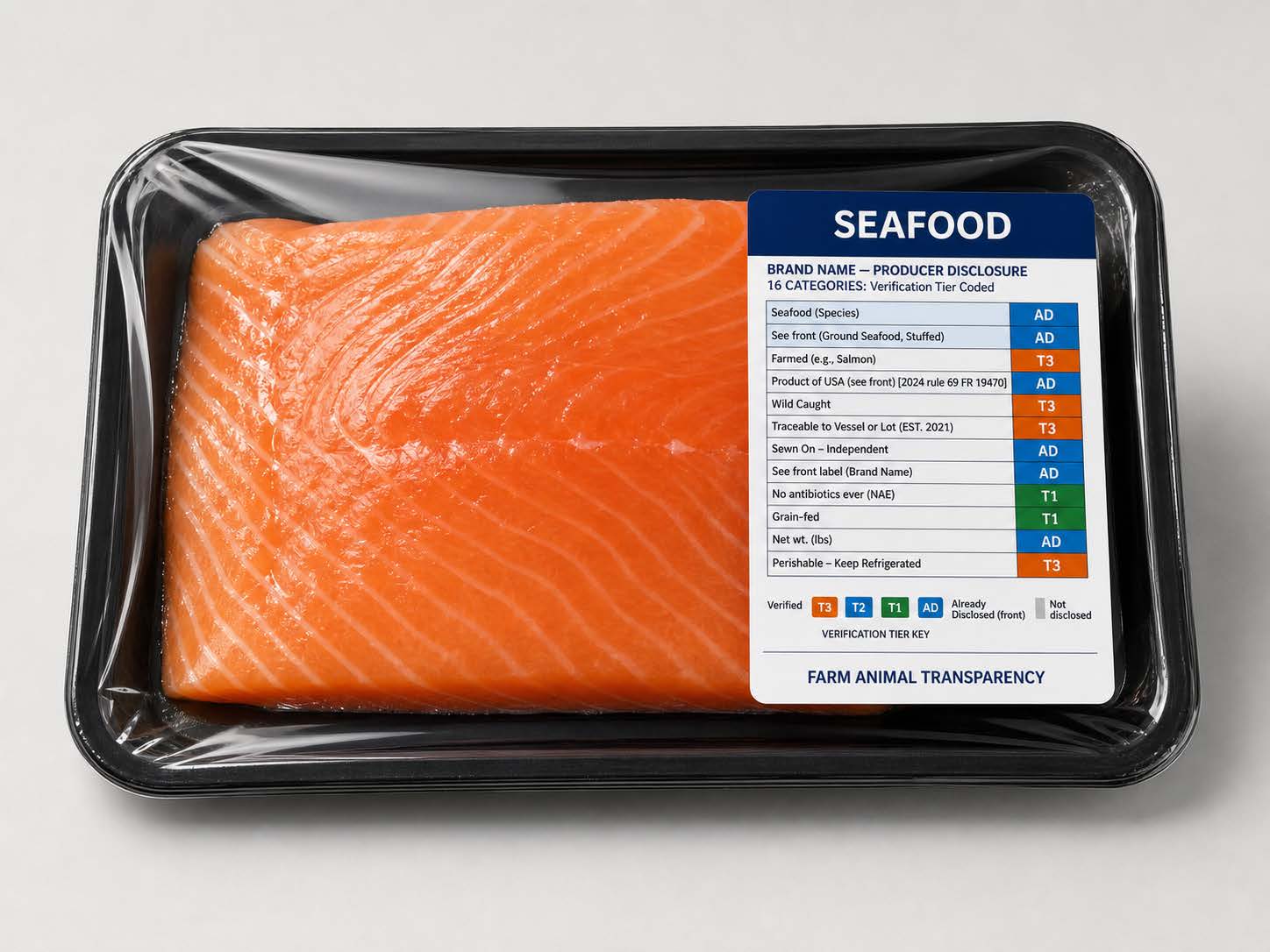
Concept illustrations of a Farm Animal Transparency disclosure label. FAT reads the disclosure a label provides; it does not certify the product or the food.
The Problem with Animal Protein Labels
Meat, poultry, and seafood labels are designed to market, not to inform. Walk into any grocery store and you will see dozens of different claims — “Natural,” “Humanely Raised,” “Sustainably Sourced,” “Grass-Fed,” “Wild-Caught” — that sound like equivalent promises but are nothing of the kind. Some are government-defined far more narrowly than they sound: “Natural” is USDA-defined for meat and poultry, but the definition covers only processing and ingredients, not how the animal was raised. Some are reviewed by USDA only on the paperwork a producer submits. And others — “Humanely Raised,” “Sustainably Sourced” — have no federal definition or standardized verification requirement at all.
The regulatory picture is fragmented by design. USDA FSIS governs beef, pork, poultry, and catfish. FDA governs all other seafood. Neither agency requires producers to disclose where an animal was raised, what it was fed, what drugs it received, what the processing facility’s enforcement record looks like, or who ultimately owns the brand on the package. Those gaps are not oversights — they reflect decades of lobbying to keep label requirements minimal.
FAT does not accept that this is the consumer’s problem to solve. It is a disclosure problem, and disclosure can be measured.
What USDA Already Requires on Every Label
Federal law already puts a baseline of information on every USDA-inspected package. Under FSIS regulations, every meat and poultry label must carry up to eight required features: the product name; the USDA inspection legend with the establishment number of the plant that processed it; the net weight; a handling statement on perishable products; the name and place of business of the manufacturer, packer, or distributor; an ingredients statement; nutrition labeling unless the product is exempt; and safe-handling instructions on raw and partially cooked products.
That is the federal baseline. Because every inspected product must meet it, it cannot tell you anything about one brand versus another — which is why the FAT disclosure card states the baseline on every reading before any voluntary claim is counted.
Everything beyond the baseline is voluntary. How the animal was raised, what it was fed, antibiotic and hormone practices, animal-welfare standards, origin for beef and pork, the farm or ranch behind the product, “best by” dates — none of it is federally required. Those voluntary disclosures are where labels actually differ, and they are exactly what FAT reads, counts, and checks for verification.
The Three Steps of a FAT Reading
Every label — beef, pork, chicken, turkey, lamb, wild fish, farmed fish, shellfish, catfish — is run through the same three-step analysis.
Step 1 — What Is Disclosed
For each of 16 transparency categories, FAT records whether the information appears on the label and how specifically.
- ✔ Known — the label clearly discloses the information with enough specificity to be meaningful.
- ◑ Partial — some information is present but limited, vague, or non-specific.
- ✕ Missing — the label does not address this category. Absence is recorded as a disclosure gap, not as misconduct.
The 16 categories cover USDA/FSIS or FDA required basics, species, breed or strain, country of origin, farm/ranch (or vessel/fishery for seafood), age at slaughter or harvest timing, processor, Who (corporate ownership), brand, feed (or production method for seafood), animal welfare or handling, medicine, hormones where relevant, quality and palatability, organic or certification status, and supply-chain intermediaries.
Step 2 — How Credible Is the Disclosure
A “Known” disclosure is only as trustworthy as the entity standing behind it. FAT rates every Known and Partial disclosure on a four-tier credibility scale:
- Third-party audited — independent inspection body with a documented audit trail (USDA Organic, GAP, AWA, Certified Humane, MSC, ASC, BAP). Highest weight.
- USDA-reviewed — FSIS or AMS-approved label language, or a USDA Process Verified Program (PVP). Government-backed, no independent audit.
- Producer-affidavit — documented at the producer level but without independent or agency audit.
- Unverified marketing — appears on the label, allowed if not misleading, but has no documented backing.
When a category is Missing there is nothing to rate for credibility — the label simply did not address it.
Step 3 — Who Stands Behind the Label
A label is only as credible as the entities behind it. FAT surfaces the accountability chain on every reading:
- The processor, identified by FSIS establishment number (meat, poultry, catfish) or FDA registration (other seafood) — and the processor’s public enforcement record: recalls, residue violations, humane-handling actions, FDA import alerts.
- The brand owner and the corporate parent — who actually controls the label.
- Beneficial ownership and foreign ownership — particularly relevant when foreign-controlled entities make claims about U.S. animals or seafood (Smithfield is owned by China’s WH Group; National Beef is owned by Brazil’s Marfrig).
- Economic concentration — Herfindahl-Hirschman Index (HHI) and market-structure data for the relevant species and regulatory regime, because concentrated systems shape what gets disclosed and what gets standardized away.
The accountability chain is the part of the reading that a producer cannot rewrite. It is the public record.
The FAT Disclosure Card
Every scan returns one card. It leads with a plain count — how many of the 16 transparency categories the label discloses — shown as a meter, not a letter grade and not a red/amber/green verdict on the food. The card also states the federal baseline every product already meets (FSIS inspection for meat and catfish; FDA labeling basics for other seafood), names the categories the label is silent on, shows a verification pill for each disclosure, and surfaces any EPA or OSHA public-record line for the processor. A count, not a grade: FAT rates what the label discloses and how credibly it is backed — never the quality, safety, or taste of the food.
How Strongly Each Claim Is Backed
Counting a category as disclosed answers only half the question. The other half is: who vouches for the claim? For every disclosed category, the card shows one of four verification labels:
- Third-party audited — an independent, accredited certifier inspected the operation and put its name behind the claim (USDA Organic, GAP, AWA, Certified Humane, MSC, ASC, BAP).
- USDA-reviewed — the claim went through a USDA process, such as FSIS label approval or an AMS Process Verified Program. Government-backed, but not independently audited.
- Producer affidavit — the producer signed a statement attesting to the claim; no outside audit.
- Unverified marketing — the claim appears on the package or website with no documented backing FAT could find.
These labels do not change the disclosure count — a claim counts as disclosed either way. They sit next to each category so you can see, at a glance, not just how much a producer told you but how well each statement is backed.
Behind the scenes, FAT also maintains an internal weighting — categories that add more transparency, and claims that are better backed, count for more. That weighting orders and emphasizes disclosures in FAT’s producer-facing tools; none of its arithmetic appears on the shopper’s card, which always leads with the plain count. The per-category detail lives on the meat and seafood methodology pages.
What the disclosure count does not tell you: The count measures one thing — how much the producer disclosed, and how each disclosure is verified. It is not a rating of quality, taste, or nutrition; not an environmental score; not a judgment of price or value; and not a recommendation to buy or avoid anything. A higher count means the producer told you more and backed it up better. What you do with that information is your decision.
Reading Each Category
Every one of the 16 categories carries one of three disclosure states, and each disclosure carries a verification tier. These describe the label — not a verdict on the food. FAT uses a consistent visual language on every category card so a shopper can read a full transparency profile at a glance:
- Known — the category is clearly disclosed; the verification tier records how well it is backed, with third-party audited the strongest (independent, accredited certifier — USDA Organic, GAP, Certified Humane, AWA, MSC, ASC, BAP) and unverified marketing the weakest.
- Partial — some information is present but vague or non-specific, or backed only by a producer affidavit or a USDA-reviewed program (government-backed but not independently audited — a USDA Process Verified Program lands here).
- Missing — the label does not address the category. A gap, not an accusation — and never a mark against the food itself.
How “USDA Process Verified” Is Scored
A “USDA Process Verified” shield is not a single claim — it is a wrapper around whichever claims a company chose to have USDA verify. One company’s program verifies source and age; another’s verifies no antibiotics; another only Product of USA. FAT therefore does not award a blanket “verified” checkmark for a PVP shield.
Instead, FAT looks the program up in its verification registry — compiled from the public USDA AMS listings (Process Verified, Non-Hormone Treated Cattle, Quality System Assessment, Grass Fed, Livestock Feeding Claims, and Bovine Export Verification) — and applies USDA-reviewed credit to only the specific categories that program actually verifies. Every other category is scored on its own evidence.
For example, a package carrying the American Wagyu Association program (USDA certificate PV5280ZZA) earns USDA-reviewed credit in Breed (3), Country of Origin (4), Farm / Ranch (5), Age at Slaughter (6), Processor (7), Feed (10), and Supply-Chain Intermediaries (16) — the categories that program verifies — and earns nothing in, say, Animal Welfare (11) or Hormones (13), which it does not cover. A bare “USDA Process Verified” with no identifiable program is treated as unverified marketing until the program is matched.
This keeps a government-backed verification from inflating categories it never touched, and credits exactly the ones it does.
What FAT Reads — and What It Does Not
FAT does read: whether a label discloses each of 16 transparency categories; how credible each disclosed claim is; what enforcement records are linked to the processor on the label; what the corporate structure behind the brand actually is; and what supply-chain intermediaries sat between the farm and slaughter.
FAT does not judge: food safety, taste, or nutritional quality; whether a production practice is ethically right or wrong; whether a product is worth buying. A label that discloses everything transparently reads well regardless of whether you approve of the production method — and a label that discloses little reads as a low count even if the product is excellent.
Enforcement Data — Step 3 in Action
One element of the FAT reading goes beyond what appears on the label itself. When a label carries a USDA FSIS establishment number — required on all USDA-inspected meat, poultry, and catfish — FAT retrieves real-time enforcement data from public FSIS datasets and links it to that label. This covers six enforcement areas: recalls, administrative actions, humane handling violations, quarterly enforcement actions, chemical residue violations, and pathogen testing results.
For FDA-regulated seafood, FAT queries FDA import alert history and Seafood Import Monitoring Program (SIMP) compliance records linked to the processor. No other consumer-facing tool connects this enforcement data to the label at the point of purchase.
Alongside these food-safety records, FAT surfaces a separate worker-safety record for the processing plant — OSHA inspections, citations (serious, willful, repeat, and other-than-serious), and penalties, drawn from U.S. Department of Labor enforcement data. It is kept deliberately distinct from the food-safety areas above and never blended into a single number: whether a plant’s product is safe to eat and how it treats the people on its line are two different questions, and FAT reports them separately.
Category-by-Category Details
The 16 categories are adapted for each product type. Choose the relevant page for full definitions and the per-category weight table.
- 🥩 How FAT Reads Meat Labels → — the full 16-category meat methodology, including USDA establishment lookup, FSIS enforcement data, foreign ownership, HHI, and supply-chain intermediaries for beef, pork, chicken, turkey, and lamb.
- 🐟 How FAT Reads Seafood Labels → — the full 16-category seafood methodology, including the Siluriformes exception, wild vs. farmed, MSC / ASC / BAP credibility tiers, chain-of-custody intermediaries, the service-case counter flow, and how seafood categories differ from meat.
- 🛒 For Consumers — Shopping with FAT Labels →
- 🚜 For Producers — Enhancing Transparency in Farm Animal Production →
Last reviewed: July 2026. Reframed to the disclosure-count card model — count not letter grade, meter not traffic light, federal baseline on every card, rates the disclosure never the food. The weighting section was simplified in July 2026: verification now appears as plain labels on the card, and the internal weighting detail lives on the meat and seafood methodology pages.